
What More Than 5,000 Oklahoma Wildlife Inspections Over 10 Years of Field Data Reveal About Local Wildlife Problems
Published July 16, 2026
By Brad McKey, Owner of True Care Wildlife
Executive Summary
After completing more than 5,000 residential wildlife inspections across the Oklahoma City metropolitan area over the past decade, our team at True Care Wildlife has identified a clear pattern:
Wildlife problems are not evenly distributed across the metro.
Every community experiences wildlife intrusions, but our inspection records show recurring differences:
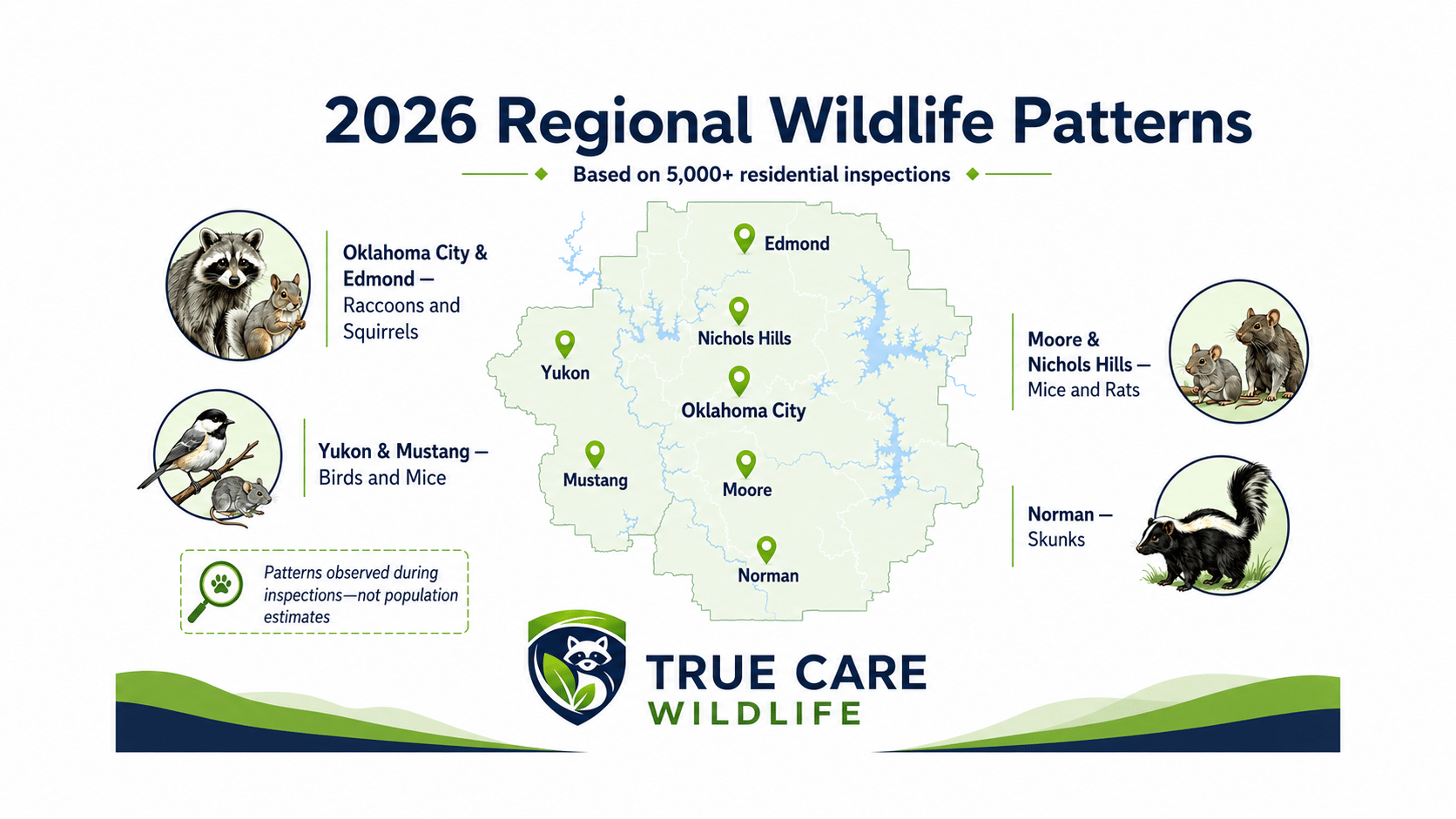
- Oklahoma City and Edmond: A broad mix of wildlife problems, led by raccoons and squirrels
- Norman: A comparatively high number of skunk-related inspections
- Moore and Nichols Hills: Rodents appear more frequently
- Yukon and Mustang: Birds and mice are commonly encountered
These findings do not estimate wildlife populations within each city. They summarize the primary species confirmed during residential inspections and examine how housing design, neighborhood age, surrounding habitat and development patterns may influence the wildlife problems homeowners experience.
The central finding is simple:
Wildlife follows opportunity—not city limits.
About the Inspection Data
This report is based on residential wildlife inspections completed by True Care Wildlife throughout the Oklahoma City metropolitan area.
Study Scope
- More than 10 years of residential wildlife inspection experience
- More than 5,000 homes inspected
- Approximately 780 residential inspections completed during the past 12 months
- Seven Oklahoma City metro communities reviewed
Communities Included
- Oklahoma City
- Edmond
- Norman
- Moore
- Yukon
- Nichols Hills
- Mustang
Primary Wildlife Categories
Methodology
Each property was categorized according to the primary wildlife species confirmed during the inspection. Each property was counted once.
This analysis identifies recurring patterns among homes inspected by True Care Wildlife. It is not a wildlife population survey and should not be interpreted as an estimate of the total number of animals living within any community.
The report is intended to help homeowners understand how housing characteristics, neighborhood design and surrounding habitat may influence the wildlife problems encountered in different parts of the Oklahoma City metro.
Oklahoma City Metro Wildlife Patterns at a Glance
| Community | Wildlife commonly observed during inspections | Conditions commonly associated with activity |
|---|---|---|
| Oklahoma City | Raccoons, squirrels and a broad mix of species | Diverse housing, mature trees, urban habitat and roofline vulnerabilities |
| Edmond | Raccoons, squirrels and a broad mix of species | Wooded properties, greenbelts, ponds, mature neighborhoods and new development |
| Norman | Skunks | Decks, porches, sheds, crawlspaces, creek corridors and open spaces |
| Moore | Mice and rats | Construction gaps, drainage systems, utility corridors and expanding subdivisions |
| Nichols Hills | Mice and rats | Mature landscaping, older infrastructure, irrigation and detached structures |
| Yukon | Birds and mice | New construction, open land, vent openings and small exterior gaps |
| Mustang | Birds and mice | Expanding neighborhoods, former agricultural land and available nesting cavities |
Key Findings
Analysis of more than 5,000 residential inspections produced six recurring findings:
- Wildlife follows opportunity rather than municipal boundaries.
- Housing styles and neighborhood design influence which species are encountered.
- Small construction gaps are the most common access points associated with mice and rats.
- Roofline vulnerabilities account for many raccoon and squirrel intrusions.
- Ground-level shelter contributes to many skunk denning problems.
- Expanding suburban development produces different wildlife challenges than established neighborhoods.
Oklahoma City and Edmond Wildlife Patterns
Why Oklahoma City and Edmond Experience a Wide Variety of Wildlife Problems
Oklahoma City and Edmond produce some of the broadest mixes of residential wildlife activity observed during our inspections. Raccoons and squirrels are encountered especially often, but rodents, birds and other wildlife are also regularly found.
The variety of housing and habitat throughout these communities helps explain the pattern.
Oklahoma City and Edmond contain historic neighborhoods, mature subdivisions, custom homes, new construction, wooded properties, neighborhood ponds, parks, greenbelts and rapidly developing areas. This diversity creates opportunities for multiple wildlife species rather than one consistently dominant animal.
Mature trees can provide squirrels with direct access to roofs. Raccoons commonly enter through damaged soffits, roof vents, turbine vents, roof intersections and weakened construction materials.
The age of a home does not necessarily determine whether wildlife can enter. Older homes may develop vulnerabilities as materials deteriorate, while newly constructed homes may contain unprotected vents or small gaps where building materials meet.
In most cases, raccoons and squirrels take advantage of an existing weakness in the home rather than creating an entirely new entry point.
Norman Wildlife Patterns
Why Skunk Problems Stand Out in Norman
Among the Oklahoma City metro communities included in this report, Norman produces a noticeable number of skunk-related inspections.
Unlike raccoons and squirrels, which commonly occupy attics, skunks typically establish dens beneath ground-level structures.
Common skunk denning locations include:
- Decks
- Porches
- Sheds
- Crawlspaces
- Retaining walls
- Foundations
Many Norman neighborhoods are located near wooded areas, creek corridors, parks and open spaces that support wildlife movement. Homes bordering these environments may provide convenient denning opportunities beneath ground-level structures.
During skunk inspections, the point of access is not always an existing construction defect. Skunks frequently create their own access by digging beneath a deck, porch, shed or foundation.
Homeowners commonly discover the problem after noticing excavation around a structure, hearing movement underneath it or detecting skunk odor around the property.
Why Are Skunk Problems Common Around Norman Homes?
Drawing from more than 5,000 Oklahoma residential wildlife inspections, we explain why skunks dig beneath homes, why filling one hole may not work and when a buried animal-deterrent wall may be needed.
Read the Norman skunk inspection findings →Moore and Nichols Hills Wildlife Patterns
Why Rodents Appear More Frequently in Moore and Nichols Hills
Moore and Nichols Hills are very different communities, but mice and rats appear frequently during residential inspections in both areas.
Moore continues to experience residential expansion around drainage systems, creeks, utility corridors and closely connected subdivisions. As development changes the surrounding environment, small gaps around foundations, garages, rooflines and utility penetrations can provide rodents with access to homes.
Nichols Hills presents a different environment. Large established homes, mature landscaping, irrigation systems, detached structures, older infrastructure and abundant vegetation can provide rodents with shelter, food and protected travel routes.
Despite their differences, the two communities share one important vulnerability:
Most rodent intrusions begin with small construction gaps that are easy for homeowners to overlook.
Mice and rats can enter through remarkably small openings before moving into garages, walls and attics. Identifying and permanently closing those openings is one of the most important steps in preventing recurring rodent activity.
Yukon and Mustang Wildlife Patterns
Why Birds and Mice Are Common in Growing Communities
Yukon and Mustang have experienced substantial residential development as neighborhoods expand into former agricultural land and open fields.
During inspections in these communities, birds and mice appear especially frequently.
Birds commonly establish nests inside:
- Roof vents
- Bathroom exhaust vents
- Gable vents
- Soffit openings
- Other protected exterior cavities
Mice commonly enter through small gaps around foundations, exterior transitions, attached garages, utility penetrations and rooflines before moving into walls and attics.
Development does not create wildlife. Instead, it places new homes within existing habitat while providing new structures with nesting and shelter opportunities.
A newly constructed home can still experience a wildlife problem when vents remain unprotected or small construction gaps are left accessible.
The Most Common Wildlife Entry Points
How Do Skunks Get Beneath Oklahoma Homes?
Skunks most commonly create access by digging beneath decks, porches, sheds, crawlspaces and foundations. These protected spaces can provide suitable locations for seasonal or maternal dens.
Unlike many attic-dwelling species, skunks may create a new opening rather than relying on an existing construction gap.

How Do Mice and Rats Enter Oklahoma Homes?
Mice and rats commonly enter through small construction gaps around:
- Foundations
- Utility penetrations
- Rooflines
- Attached garages
- Exterior material transitions
- Doors and garage seals
Because rodents can use openings that are difficult to notice from the ground, the entry point may remain undetected even after activity is discovered inside the home.
How Do Raccoons Enter Attics?
Raccoons frequently enter through damaged soffits, roof vents, turbine vents, roof intersections and weakened roofline materials.
Their size and strength allow them to enlarge an already vulnerable area. However, the original opportunity often begins with deterioration, storm damage or a weakness where different parts of the roof meet.
How Do Squirrels Get Into Attics?
Squirrels commonly enter through soffits, eaves, roof returns and damaged roofline materials.
Their climbing and chewing abilities allow them to reach elevated areas and enlarge small existing openings. Trees and branches near the roof can make these vulnerable areas easier to access.
Where Do Birds Nest on Oklahoma Homes?
Birds frequently nest inside roof vents, bathroom exhaust vents, gable vents and other sheltered exterior cavities.
Unprotected vents are particularly attractive because they provide cover from weather and predators. Nesting material may also restrict ventilation or interfere with the intended function of the vent.
What Do These Findings Mean for Oklahoma Homeowners?
The most important lesson from more than 5,000 residential wildlife inspections is that wildlife rarely enters a home without an opportunity.
Different properties create different opportunities:
- Mature trees give squirrels access to roofs.
- Decks and ground-level structures offer shelter to skunks.
- Small construction gaps allow mice and rats inside.
- Damaged rooflines create entry points for raccoons.
- Unprotected vents provide nesting locations for birds.
The species may differ by city, neighborhood or property, but the underlying pattern remains consistent:
Wildlife problems begin when a home unknowingly provides access, shelter or both.
Understanding how the home became vulnerable is often the first step toward preventing recurring wildlife activity and avoiding more extensive damage.
Removing an animal may resolve the immediate concern, but it does not necessarily correct the condition that allowed the problem to begin. A complete inspection should identify the animal involved, determine how it entered and evaluate whether other vulnerable areas are present.
https://truecarewildlife.com/wildlife-removal-services
Frequently Asked Questions
What Is the Most Common Wildlife Problem in the Oklahoma City Metro?
No single species dominates every part of the Oklahoma City metro. Raccoons and squirrels are frequently encountered in Oklahoma City and Edmond, skunks stand out in Norman, rodents appear frequently in Moore and Nichols Hills, and birds and mice are common in Yukon and Mustang.
These are recurring patterns documented during True Care Wildlife inspections, not estimates of the total wildlife population in each city.
Do These Findings Show How Many Wild Animals Live in Each City?
No. This report summarizes the primary species confirmed during residential wildlife inspections. It does not estimate wildlife populations or include every wildlife incident occurring within each community.
The findings reflect the types of problems homeowners contacted True Care Wildlife to inspect.
Are Older Homes More Likely to Have Wildlife Problems?
Not necessarily. Older homes may develop openings as materials age, shift or deteriorate. Newer homes may contain unprotected vents or small construction gaps left where different building materials meet.
Wildlife can enter a home of any age when a suitable opening and shelter opportunity are present.
Why Do Wildlife Problems Differ Between Nearby Cities?
Housing design, neighborhood age, tree coverage, open space, drainage systems, development patterns and available shelter all influence which wildlife species homeowners encounter.
Even neighboring properties may experience different problems when their rooflines, landscaping or exterior construction differ.
Can Sealing Entry Points Prevent Wildlife From Returning?
Professional wildlife exclusion can significantly reduce the likelihood of animals returning through known vulnerabilities. However, the property should first be inspected to identify the species, locate its entry points and ensure animals are not sealed inside.
The appropriate repair depends on the animal involved, the location of the opening and the condition of the surrounding materials.
Does Removing the Animal Solve the Entire Problem?
Not always. Removing the animal addresses the immediate activity, but the home may remain vulnerable if its entry point is not identified and repaired.
Long-term wildlife control may also require cleanup, sanitation or repair of damage left behind inside the attic, walls or other affected areas.
About This Research Series
The True Care Wildlife Research Series examines recurring wildlife patterns documented during residential inspections across the Oklahoma City metropolitan area.
By sharing findings from more than 5,000 home inspections, True Care Wildlife aims to help Oklahoma homeowners understand how animals enter homes, why certain problems appear more frequently in different communities and how structural vulnerabilities can be addressed.
Future research briefs will examine:
- The most common wildlife entry points found on Oklahoma homes
- Seasonal wildlife activity throughout the year
- How home age and construction influence wildlife problems
- Construction vulnerabilities identified during inspections
- Wildlife damage inside Oklahoma attics
- Why wildlife problems return after incomplete or unsuccessful repairs
About the Author
Brad McKey is the owner of True Care Wildlife, an Oklahoma-based wildlife removal and home-exclusion company serving the Oklahoma City metropolitan area.
McKey and the True Care Wildlife team have completed more than 5,000 residential wildlife inspections. Their work focuses on identifying how animals enter homes, resolving immediate wildlife problems and helping homeowners reduce the risk of future intrusions through professional wildlife exclusion.
True Care Wildlife’s approach is guided by the belief that understanding the home is just as important as identifying the animal:
The animal is why we’re called. The home is why we’re there.
Leave a Reply